I have had a great experience here teaching two condensed classes, one undergraduate class on economic systems for three weeks in February and one master's class on development economics for two weeks in April/May. I mention the duration of these classes partly because I typically teach semester-long courses and partly due to the fact that the first class (which concluded on March 2 with the final exam) is still not officially closed.
One of the things I have learned here, which has been a major source of frustration, is that one must be very flexible when navigating the education system. The students in my first course are in their final semester of their degree, and they must complete this class in order to graduate. Yet, several students did not attend the class at all or they attended only one or two sessions. In America this behavior would result in failing the class and coming back in fall. Not here. The excuses are many, from "I had to work during your class" to "I was in Poland" to "It has been a busy term" to, very sadly, "My dad took his own life in December."
The university has a policy that these students have several weeks, and several chances, to schedule a make-up time to take a final exam and pass the class (the final exam is worth seventy percent of the course grade). What's more, this is a fluid policy and the several weeks has turned into two-and-a-half plus months. So I send a student who never once attended the class several articles and slides, ask them to read and study the materials, and then show up at a certain time to take a written exam. The expectation is that if the students follow these instructions they will at least pass the course.
As a representative of the U.S., and someone who is here on behalf the U.S. State Department, I am encouraged to be a positive voice in the education system, trying at least to show a different (and hopefully improved) way of teaching, relating to students, etc. It is unlikely that my lone voice at the Academy of Economic Studies will make a difference, but I'm trying to tell anyone who will listen that this system hurts the integrity of the institution. The students who worked hard and attended the course everyday are classified with someone who never showed up once. I certainly had some students who were stellar, and they did far better than those who never attended the class, but what I am learning is that in other courses this distinction (as to whether one attends the course or not) does not have a significant impact on the grade received.
I'm hopeful that positive changes that will help bring some credibility to the higher educational system here will soon evolve in the coming years. For now, students are continuing to enter the universities here with the option of skating through without anything close to the effort one would expect of a college education.
I'm speaking at a conference this weekend where I will hopefully address some of these issues, and I'm learning that small/incremental changes are the only kind in Moldova.
Monday, May 14, 2012

Sunday, May 6, 2012
Spring Clean-Up
It has been very nice in Moldova lately as we have transitioned from the coldest winter in Eastern Europe in a generation to what is turning out to be a warmer than normal spring. When we arrived here in early January, it was striking how dirty and gray everything was. The streets were full of dirt, mud, and eventually a lot of snow and during the snow melt-off there were small brown steams everywhere. Also, it seemed that people were not very careful with putting trash where it belongs and keeping things nice. Part of this is due to typical city living with a lot of apartment and rental housing and with a lot of public property to dump trash on. It was very hard to imagine that Chisinau would ever look like all the pictures displayed on postcards, maps and the other publications highlighting how green this city is.
Yet, as the weather warmed we saw people all over the city cleaning up. Some of them were city workers who spent considerable time sweeping the streets and cleaning areas around trash dumpsters and other public places.

Also, we began to see people everywhere painting curbs and tree-trunks white (something they do all over the city) in order to make things look nice.
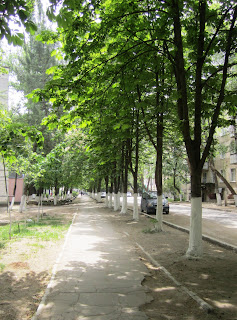
It has been a beautiful and welcome transformation around here as moods are certainly affected by the weather and springtime here is turning out to be quite beautiful.
Below is our favorite park...

Yet, as the weather warmed we saw people all over the city cleaning up. Some of them were city workers who spent considerable time sweeping the streets and cleaning areas around trash dumpsters and other public places.

Also, we began to see people everywhere painting curbs and tree-trunks white (something they do all over the city) in order to make things look nice.

It has been a beautiful and welcome transformation around here as moods are certainly affected by the weather and springtime here is turning out to be quite beautiful.
Below is our favorite park...

Sunday, April 22, 2012
The Registration Process
When I originally accepted the grant to Moldova, one of the conditions for being here for more than six months was that the U.S. Embassy would take care of our registration/visa process. This was a huge relief because it is expensive and time consuming getting six visas. We simply had to give our embassy contacts a passport photo of each of us, a copy of our passport, and sign a couple of forms. Done.
Well, two months into our stay, the Moldovan government changed the process for us and it has turned out to be another one of the joys of living in a developing country. We all had to go to a local hospital and get our blood typed, sign new forms, pay additional money, and take a trip to the ministry of registration/documentation (or something like that).
So, earlier this week Amy and I, along with Miles and Rayna, traveled to the embassy and met with Valentina (my primary contact there) and then we traveled by embassy transport to the aforementioned ministry building. We ending up meeting with four different people in this building, going from unmarked door to unmarked door. We ended up having to pay an additional fee beyond the stated amount we were told ahead of time (this was for some sort of expedited process, of all things), and we had to get pictures taken again (for Amy this was the third time). Throughout this process, Valentina had to talk with several different people, and we just blindly followed her from floor to floor.
The bottom line is that we should receive our "legitimatize" with one month to spare before we leave. This allows us to exit the country and re-enter (otherwise if we leave we will be denied re-entry), and presumably this documentation is necessary so that when we leave for good we will not have to pay a fine. After all we have spent, I'm not so sure we'll make out in the end.
Monday, April 16, 2012
Developing Country: A Continuing Series – Entrepreneurial Ubiquity
As I posted earlier, in my research of the informal economy I've been spending time in the open markets visiting merchants of all types. There are many reasons for the numerous merchant/entrepreneur, some driven by necessity and others driven by the best profit opportunity, but there are people selling things everywhere. Any place where people gather, you will find people selling agricultural products, household items, clothing, etc.
In addition to the guy (or very often woman) sitting on the street corner displaying their wares, the Magazins are almost on every corner (think mini convenience store). These are stand alone sheds, or small stores built into the side of a building, and they are available everywhere to provide food items (mostly) in all areas of this city. Everyone where I have been in the city, there is one of these Magazins (also called an Alamentara) within a few minutes walk. From our house we can walk to four of these stores in one to three minutes. One of them sells bread, cured meats, dairy products, canned goods, alcohol, ice cream, cookies, etc. and another will sell mostly produce, and another fresh meat.

I'm still learning about the structure and organization of these myriad entrepreneurial ventures. Some of the merchants in the open markets have a permit to sell, and the overall market is regulated to some extent by the government. But, there are many merchants on the street especially in the areas around the open markets. These street merchants often set up shop on their own, and in many areas they are illegally operating. This seems to frustrate those that operate with a permit, but there is no enforcement to kick out the non-permitted merchants and if the police do happen by they are easily bribed to move on.
The picture above is favorite shop located about a minute from our house. It is a little shop that sells Moldovan wine from a vineyard about 45 kilometers away. The sign says Regresar and I'm sure something is lost in translation because it literally means regression. This wine is quite good and very inexpensive so we're enjoying this local convenience.
Wednesday, April 11, 2012
Developing Country: A Continuing Series - Paying Bills
One of the joys of living in a developing country is paying bills similar to American life 50 years ago. Actually, I'm not sure if this was ever the means of bill-paying in America, but the method here is physically taking the bills to the bank and waiting in line to pay. This is simply how it is done. There is no place to mail in the payment (for most this would mean mailing a wad of cash), and there is certainly no online means to pay.

The bills come in the mail as a simple piece of paper (not in an envelope), and there is no envelope provided to mail the bill to the service provider. So after I collect all the bills for the month I head to the bank. One nice thing is that banks are ubiquitous here in Moldova (as well as ATMs). This is likely because the economy is mainly cash based (I've only seen a credit card used twice in my almost daily trips to the store).
But back to bill-paying. I found out the hard way that it is unwise to wait until the day the bills are due (or the last couple of days) and head to the bank. My first bill-pay experience necessitated that I wait in line for 45 minutes.
Picture the scene of walking into a bank with only two teller stations open and a room with people everywhere. No organized lines, but somehow each person seems to have knowledge of who is next and to which teller they are waiting. I have little ability to ask questions and figure out the chaos, but I know which teller I want to handle my transaction (she speaks a little English) but I don't know how to get there. So after 45 minutes, and one loud irate woman (not directed toward me - thankfully), I finally forged ahead to pay my bills.
I learned my lesson from this first bill-pay experience...go to the bank in the morning, mid-week, and well before the due date.
Tuesday, April 3, 2012
Soviet Order
Even the parks are created with trees in nice neat rows...


...yet you can't always keep track of a stray acorn.
Sunday, April 1, 2012
Research on the Informal Economy
This week I started a research project with a few students in which we are trying to get a handle on the behavior of entrepreneurs in the informal economy (those that sell household wares, agricultural products, and other goods bought at wholesale and sold in an open market). We are trying to get an estimate on how these folks behave in terms of taxation --and evasion -- due to the fact that their work is hidden from formal government reporting.
Previous research proposed that these entrepreneurs will maximize their private returns regardless of the cost to society (by avoiding taxes), yet this belief has been questioned recently and seems to be more complex here in Moldova.
So in order to get a better idea of how these entrepreneurs behave, we set out in one of the large open markets near our home and began to survey them. I had my two students conduct all the interviews/questioning (in Russian or Romanian) and we are pleased with the response rate so far. Most folks answered the questions (we didn’t ask for any personal information) and they appeared to be very forthright. I think my students explaining that we were not from the government and have no interest in reporting anything except cumulative data helped the merchants' willingness to respond.
The open market commerce here is quite significant given the great strides in development that has occurred during the past decade. It has been within the past 8-10 years that grocery stores became prevalent here in the city of Chisinau, and they are still only common in the cities throughout the country. Yet, many people still shop and sell items in these street markets. In the market that we walk to, it is quite a picture in contrasts as on the same street where people are selling everything from valves for plumbing to vegetables to shoelaces, there is also a nice grocery store and a high-end electronics store. Also, right across from where people sell any cut of meat you could want, out in the open, a new, really nice specialty meat shop/deli just opened last week. It will be interesting to see how long the open markets last as the economy continues to grow and transition.


We have another scheduled survey at the biggest marketplace in Chisinau next week, so hopefully we’ll have some more data to work with. It will be interesting to see what we find.
Subscribe to:
Posts (Atom)